

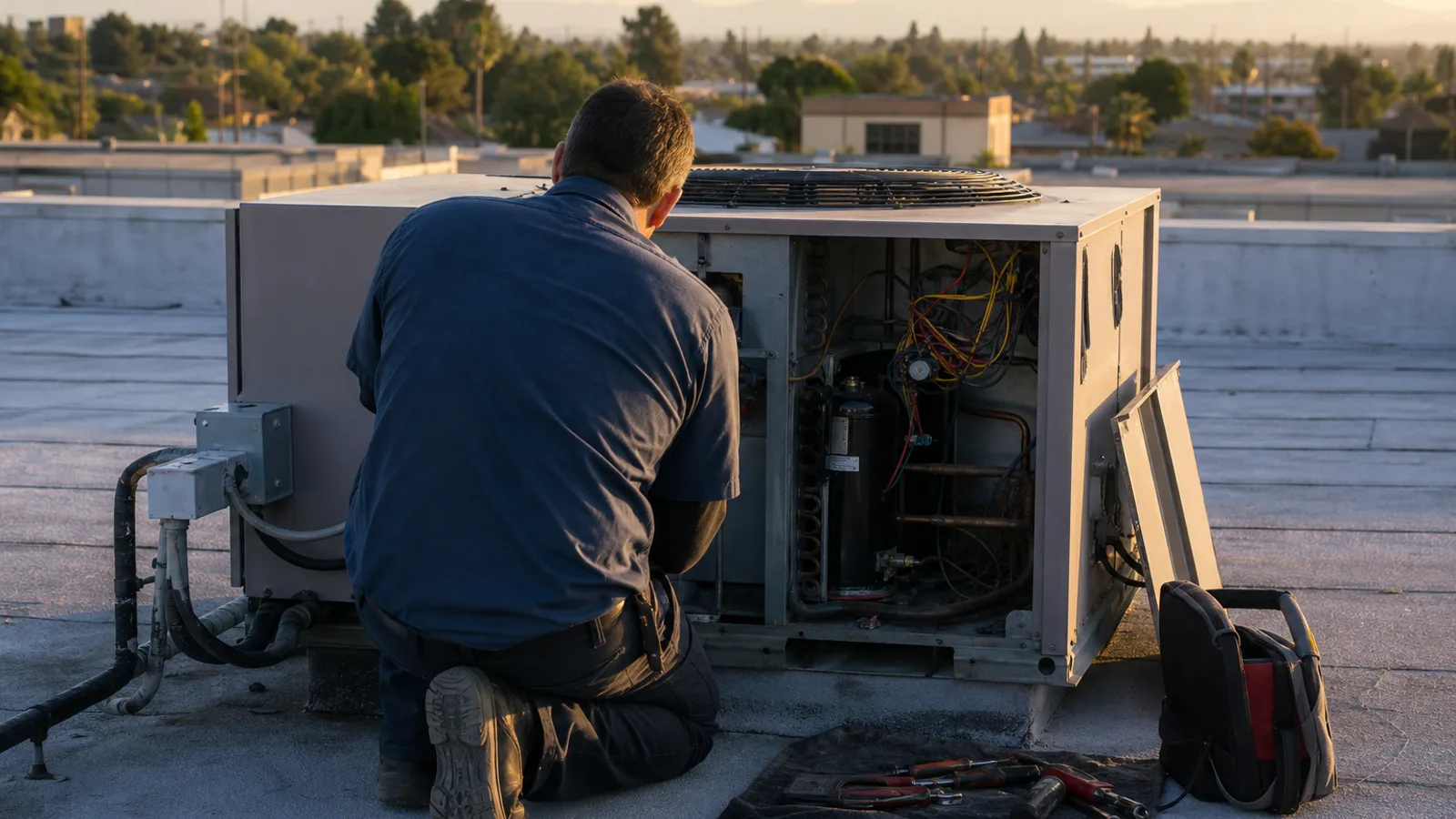
Why is website design for HVAC different from a normal contractor site?
Because the visitor isn't shopping — they're triaging, usually at a bad hour. Jobber's 2026 Home Service Trends Report, built on a survey of 1,050 U.S. home-service business owners conducted in December 2025, found that over 55% of customers expect a response within the hour and 28% expect an immediate reply. Measured against that, this trade is the slowest in the report: just 11% of HVAC pros reply within an hour, compared with 26% of cleaning businesses.
Two caveats belong right here. The respondents are owners describing their customers, not consumers surveyed directly. And Jobber sells scheduling software to these businesses, so the respond-faster framing does serve its product. The gap it describes is still the one a homeowner with no heat in February closes by dialing the next name on the list.
The short version:
- The emergency path is the product. Tappable phone number above the fold on every page, not just the homepage.
- Decide who answers at 2am before you redesign anything. A faster site ringing an unattended phone converts nothing.
- The maintenance-plan page is a pricing page, not a paragraph under "Services."
- Financing goes next to the number that causes the flinch, not behind a tab.
- If you can't name the page that produced a call, you're allocating budget on feel.
Navigation, page hierarchy, even the font size on the phone number — all of it has to assume a visitor under duress. That is what makes this a different brief from a general contractor build, where the same person might spend three weeks comparing portfolios before anyone picks up a phone.
What belongs above the fold on an HVAC homepage?
A tappable phone number, the service area named in words, and an explicit emergency label — on every page, not only the homepage. On mobile that means a click-to-call button in the header rather than a printed number a panicking homeowner has to select and copy. The hero says "24/7 emergency service" in plain language. The service area names towns, so nobody has to scroll to learn whether the crew comes to their side of the county.
Roofers and remodelers can afford a slower path to contact, which is why web design for contractors treats the hero mostly as a credibility surface. Here it is a dispatch surface. Credibility can happen on the second screen.
Who answers when the phone rings at 11pm?
Settle this before touching the design, because it decides what the emergency button should even do. CallRail's 2026 roundup of home-services marketing statistics — citing Jobber, and published by a company that sells call tracking — reports that 41% of jobs booked online come in after hours. Demand keeps arriving while the office is dark. A site that routes all of it to a line nobody picks up just produces a faster disappointment.
Three honest options, and the right one depends on the size of the crew:
| After-hours option | Works when | Fails when |
|---|---|---|
| On-call rotation to a real phone | The crew is small enough that one person can carry it and dispatch | The rotation is informal, and the third handoff quietly becomes voicemail |
| Live answering service | Volume justifies it and the script can identify a true no-heat emergency | The service books anything that breathes, and mornings start with junk on the calendar |
| Online booking for non-emergencies | The problem can wait until morning and the homeowner would rather not talk | It is the only option offered, and a real emergency gets funneled into a form |
Owners usually want the third one, because it is the cheapest and it looks modern. It is also the one that quietly loses the highest-value calls — a compressor failure at midnight is not a form-fill. That's my read from doing teardowns, not a measured benchmark, so weigh it accordingly. The safe build pairs them: a booking widget for the non-urgent, a human path for the rest, and one sentence on the page saying plainly which is which.
According to our survey, customer expectations for speed are high: over 55% expect a response within the hour, and 28% expect an immediate reply. — Jobber, 2026 Home Service Trends Report
How should the maintenance-plan page be built?
As a pricing page — tiers, what each visit includes, renewal terms, and an enrollment button — not three sentences under "Services" ending in "Contact Us." It is the one page that sells recurring revenue instead of a single job. Jobber's HVAC trends breakdown of that same 2026 report asked HVAC businesses where their paying customers actually come from: 51% named repeat customers as the top source of new business, ahead of word-of-mouth referrals at 44% and Google Search at 36%. A maintenance plan is the mechanism that manufactures a repeat customer instead of waiting to get lucky with one.
I'll name this as a bias rather than dress it up as data: across the contractor sites I have torn down, the maintenance-plan page is almost always the weakest page on the domain. That is a pattern I have observed, not a number I have measured — and it takes about ninety seconds to check on your own site.
| Page | Typical treatment | What it should be |
|---|---|---|
| Emergency service | Buried in a "Services" dropdown | Its own page, click-to-call in the header, named above the fold |
| Maintenance plans | One paragraph, no price | Pricing table, tiers, renewal terms, enroll button |
| Financing | Hidden tab or footer link | Present on every service and pricing page |
| Service area | One page, a ZIP list, a map widget | One page per city or county, named neighborhoods |
| Equipment brands | Logo strip, no context | Brand pages tied to install and repair intent |
| Call tracking | One number sitewide | A number per money page, written into the CRM |
Why does financing belong on every page instead of a hidden tab?
Because cost is the objection that kills the call before it happens, not the one that surfaces after the estimate. Angi's 2026 HVAC replacement cost guide puts the typical range at $5,000 to $12,500 with a $7,500 average, and says the bill reaches $22,000 only when new ductwork and extras like a HEPA filtration system get added. Even the low end is a number most households have to think about for a weekend.
So put the financing line next to the price, on the same screen, every time a price appears. Website design for plumbers makes the same argument for the same reason: high-ticket trades win the decision at the moment of sticker shock, not three clicks after it.
How should service-area and equipment pages be built out?
One page per city or county actually served — naming real neighborhoods, stating a response-time expectation, listing the brands installed there. A page that says "we serve the Triangle" gives a homeowner and a search engine nothing to hold onto. A page that names Cary, Apex, and Morrisville, with the brands carried and the realistic drive time, gives both something specific.
Equipment pages earn their keep the same way. Someone searching "Trane AC repair near me" has already narrowed the decision; a page that meets that exact intent leaves them nothing left to go looking for. And the competitive math is moving in one direction — the U.S. Bureau of Labor Statistics projects 8 percent employment growth for heating, air conditioning, and refrigeration mechanics and installers from 2024 to 2034, much faster than the average for all occupations. More crews means more sites competing for the same panicked search.
How do you prove which page produced the call?
Give each money page its own tracking number, and make the source page a required field on every booked job. Without that, an owner cannot separate what the ads did from what the maintenance-plan rebuild did, and next year's budget gets set by whoever argues most confidently in the meeting.
The sequence, in order:
- Pick the pages that deserve a number — emergency, maintenance plans, financing, and each service-area page.
- Swap the number by page using dynamic number insertion, so the number on screen identifies the page it sat on.
- Keep one number constant off-site — Google Business Profile, truck wraps, invoices, yard signs — so the public listing stays consistent.
- Write the source page into the job record in whatever system holds jobs, as a required field, not a note somebody may or may not type.
- Review monthly against booked revenue, not against call volume. Volume flatters the emergency page; revenue usually credits maintenance and financing.
On tooling: CallRail's published pricing listed its entry Lead Tracking plan at $50 per month in August 2026, including five numbers and 250 minutes, with additional local numbers at $3 each. Eight tracked pages is a small monthly line item, not a capital project. CallRail also supplied one of the statistics above and sells this exact category, so treat that as a price anchor for what the category costs rather than a recommendation — several vendors do the same job, and the thing to compare is whether the call writes back into your CRM automatically.
This is the same instrumentation logic behind the GTM Teardown and the rest of the GTM Teardown hub: a site is not finished when it launches, it is finished when every path reports back what it produced.
What should HVAC companies skip, and what should they ask a vendor?
The honest skip list:
- Skip the hero video. It delays the one tap that matters on a phone at 1am.
- Skip the chatbot unless it can genuinely dispatch or book. Otherwise it is a contact form with a personality.
- Skip the blog until emergency, maintenance, financing, and service-area pages are done. Content pointed at a leaky funnel is expensive traffic.
- Skip the redesign entirely if the 11pm question has no answer yet. Fixing the answering path is cheaper and it moves revenue this week.
Questions worth asking any vendor before signing:
- Does the emergency phone number appear above the fold on every template, including blog posts and legal pages?
- Who owns the domain, the DNS, and the analytics property when the relationship ends?
- Is call tracking included, and does it write back to the CRM — or does it arrive as a screenshot in a monthly report?
- How many service-area pages are in scope, and who writes the neighborhood-specific copy?
- What is the page-speed target on a mid-range Android over LTE, not on a desktop in the vendor's office?
If you'd rather see the answers on your own domain than argue them in the abstract, book the free website mockup and we'll walk the emergency path, the maintenance page, and the tracking gap together.
Cost-curious before any of that? Average cost of website design for small business breaks down what the market actually charges, and affordable web design for small business covers where cheap is fine and where it quietly is not.